Making hand-thrown and decorated pots for 32 Years
Yellow Ware
Mocha Ware
yellow clays
clear lead-free glaze
traditional styles
Yellow Ware
Mocha Ware
yellow clays
clear lead-free glaze
traditional styles
East Knoll
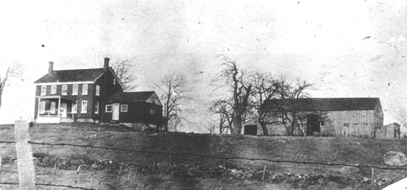
East Knoll Torringford CT c1820
One day, my sister and I were sitting at our mother's kitchen table admiring the large yellow bowls that we had grown up with. Both of us had taken pottery classes in high school and college, so we decided to try our hands at making these durable and comfortable bowls ourselves. The more we tried to figure out the clay's, temperature and glaze combinations, the more we wanted to learn just how the old potters made these wares. We began to appreciate the designs, application, durability and usefulness of the yellow ware. After many trials and errors we settled on the wares you will find today at our web site, our shops and many shops in the USA and Europe.
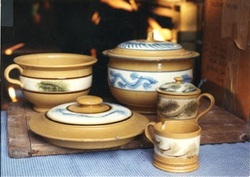
East Knoll produces hand-thrown pottery on a potters wheel, leaving ridges and imperfections that make each piece unique. The most notable feature of Yellow Ware is the yellow clay itself. Covering it with a clear, food-safe glaze brings out the natural yellow color of the clay. Depending on the amount of iron, temperature and atmosphere in the kiln, yellow shades range from buff to deep mustard. Yellow Ware also darkens with age and use.
The earliest Yellow Ware began in England as early at the 1500s, using crude local yellow clays. By the 1700s, English potters were refining their wares and began to decorate the utilitarian pots with bands and feather patterns. The earliest immigrants to the new world were sure to bring some early yellow ware with them and could purchase imports from local New England merchants.
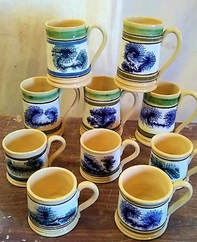
While a great deal of early Yellow Ware was plain or banded with white, brown or blue bands, creative potters experimented with other designs. Colored slip clays applied under the clear glaze became the trademark patterns now referred to as Mocha Ware. Mocha Ware patterns can be found on white and red clays too, but we especially like the yellow that is the base color of all our pots.
Colors are swirled, dipped, sponged or trailed onto a damp pot to make patterns known as Cats Eye, Worm, Balloon, Tobacco Leaf and many others that are too varried to be named.
The most popular decoration sought after today, just like in years past, is the Feather/Seaweed pattern. This is East Knolls specialty. While a pot is still damp, a band of white or colored "slip" (wet clay) is applied to the pot. An infusion of tabacco tea and coloring oxide is applied with a brush, producing a wonderful feathering effect. Many look like dragons or trees reflecting on a lake.
Our pottery is made with historically correct clays, glazes, designs and application. Variations in clay and design are to be expected and make each piece unique. Each piece is hand stamped with the potters initials. Satisfaction is guaranteed.
Thank you for your interest in our pots,
Reggie the potter
East Knoll was built about 1820 on a small knoll, east of the "highway", now called Torringford Street, that runs north to south through the village of Torringford, CT. Torringford was a small farming community settled in 1744 by farmers and craftsmen from Windsor, CT.
One of six houses built by the Birge family, ours is made from small bricks, probably made 3 miles up the "highway" at the Hayden brick yard, although the Birge family did own a brickyard 2 miles in the other direction in Harwinton and that may be where they were made and fired.
My grandfather, Frank Albrecht, bought the home in 1928 from Louise Birge Davis, and came from NYC to start a florist business on the property. I grew up here. Grampa grew flowers and vegetable plants and shipped chrysanthemums on Torringtons' train to NYC. Many flowers and vegetable plants were sold from his greenhouses, open to the public, till his death in 1971.
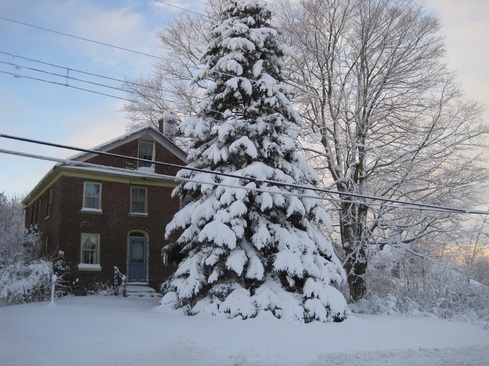
Except for the plumbing and electricity added in the 1950s, the house has changed little. All the photos on this web site were taken within, on its shelves and mantles. -Reggie
Yellow Ware
What is Yellow Ware?
The earliest Yellow Ware began in England as early at the 1500s, using crude local yellow clays. By the 1700s, English potters were refining their wares and began to decorate the utilitarian pots with bands and feather patterns. The earliest immigrants to the new world were sure to bring some early yellow ware with them and could purchase imports from local New England merchants.
Yellow Ware is made with buff-colored clay, containing less iron than red clay. All buff clays are considered stoneware because they can be fired at a higher temperature. Firing pots higher makes a pot a tighter, less porous bond than red ware pots.
All Yellow Ware is considered earthenware because it is fired a little lower then stoneware temperatures and therefore slightly porous. Although yellow clay deposits were never abundant in Connecticut, the demand for the durable pottery prompted potters to ship yellow clays from New Jersey up along New England's coast and rivers in the early 1800s.
There can be a drastic color difference in Yellow Ware pottery, old and new. This is because clay is an natural, organic material. Each individual clay deposit can have a variety of iron in the same pit. This years clay from a particular clay mine can be different in iron and other impurities from last years clay that was mined from the same pit.
The firing process, burning materials, atmosphere in the kiln, glaze ingredients and temperature can also influence the color. Age has a factor too. Like all things, age and use can darken the color of organic materials. Therefore, it is difficult to control the outcome. This makes the ware even more enduring. Knowing the reasons why the variety of color is important when collecting and buying yellow ware.
In the 1800s, the Goodwin brothers started a Yellow Ware Pottery in Hartford, CT. Asa Hill and L.V. Wheeler, Norwich Pottery Works, Chase Chamberlain, Sutenburg, Sidney Risely, Noad and George Day and the Smith Pottery all started potteries in Norwich and Norwalk and made stoneware and yellow ware, some as late as 1895. Many other potteries in New England started using these same clays to make Stoneware and Salt Glazed pottery. Bennington Pottery in Vermont still makes the same famous pottery today using these buff clays.
By the 1850s the demand for Yellow Ware was so high that large potteries in Ohio turned out thousands of pieces every year until the 1930s. Around that time, tastes changed to china with fine lines and decals, and the era of Yellow Ware came to an end.
There are still a few large potteries in operation using buff clays. Roseville in Ohio and TG Green in England are still making factory-produced Yellow Ware pottery using molds.
East Knoll today